

The doctor looked at the MRI like he’d seen this before.
“Well, my friend, you ran a marathon with a fractured tibia bone.”
I’d just finished the Chicago Marathon. All 26.2 miles of it. On a broken leg. I didn’t know it was broken until I was lying in a hospital bed in North Chicago, staring at the ceiling while the room smelled like antiseptic and humiliation.
My coach called while I was still in the bed. Wong Way Sile, not your standard running coach. Two-time NYC Marathon winner.
I expected sympathy. I got something else.
He told me about the time he was leading the NYC Marathon with five miles to go and dropped out. Exhausted. A man who won that race, walking off the course.
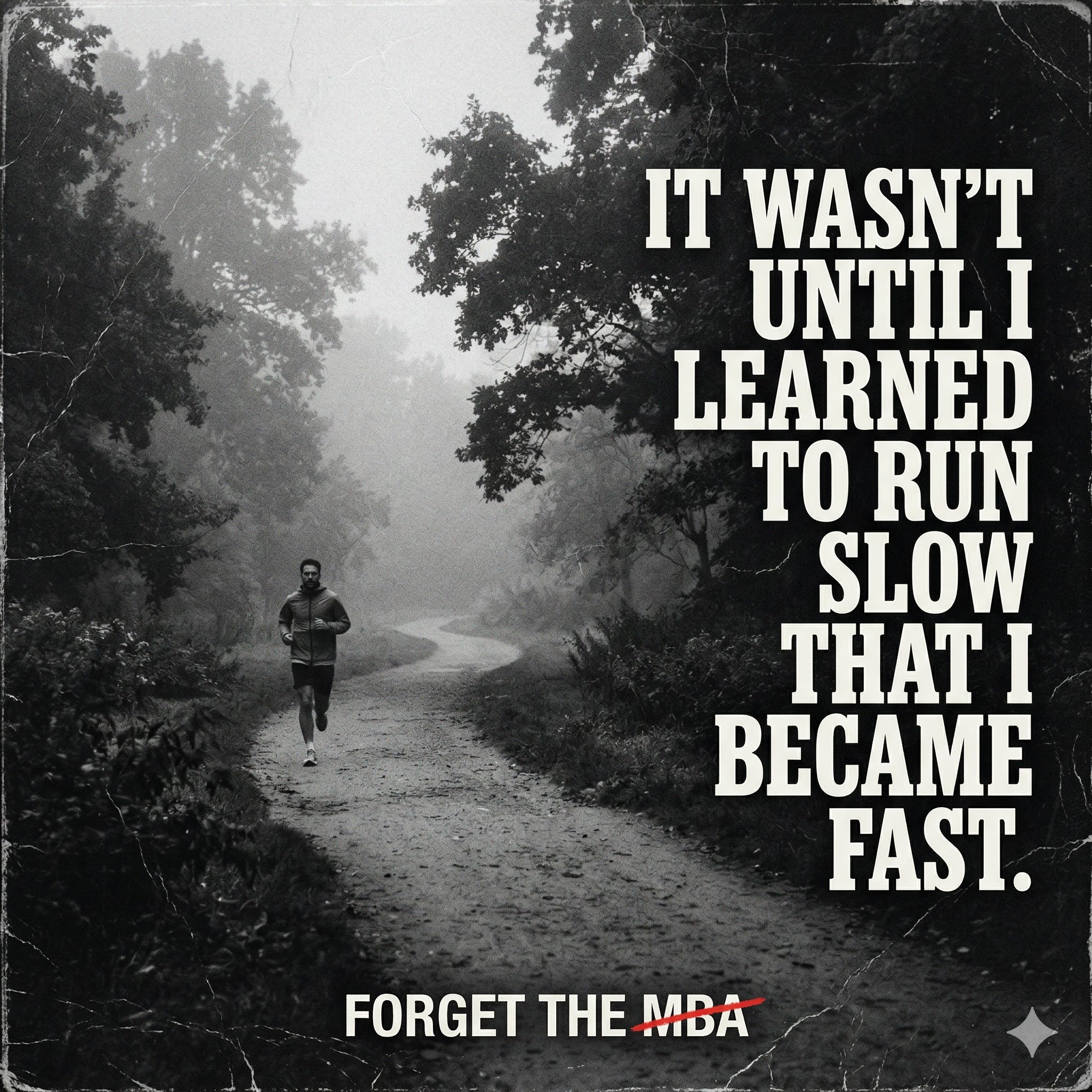
Then he said it: “It wasn’t until I learned to run slow that I became fast.”
I was too frustrated. I was lying in a hospital bed with a broken bone in my leg, and he was giving me philosophy.
It took me years to understand what he meant.
The problem wasn’t my training volume. It wasn’t my ambition. The problem was that I treated every single session like a race: crushing easy days, moderate days, all of it. Every run was at the same grinding, semi-hard effort. I thought that was toughness.
It wasn’t. It was just noise.
What I was doing, I’d later learn, is exactly what breaks most runners. Sports scientist Dr. Stephen Seiler spent years studying how elite endurance athletes actually train. He found that world-class runners, cyclists, and skiers from completely different countries and cultures had all converged on the same pattern: around 80% of training at genuinely easy effort, the other 20% brutally hard. GOREWEAR Nothing in the murky middle.
I was living in the murky middle. When recovery runs are too fast, instead of returning to full capacity you might recover to only 80–85%. So when it’s time to go hard, your body is already starting in a hole. Marathon Handbook
That’s what happened in Chicago. I showed up to the start line already depleted — from months of training that was never actually easy.
The tibia didn’t lie.
Three years later, I stood in Hopkinton. Boston. And I ran 2:38.
The difference wasn’t more intensity. It was finally understood where the intensity belonged.
When It Gets Real
Most founders I know run their companies exactly the way I ran training in 2015, I was certainly one of them.
Every day is a sprint. Every week is a crisis. Every meeting has the same urgency. We’re in the murky middle constantly, working hard enough to be exhausted, never hard enough to break through.
I’ve watched brilliant people plateau not because they lacked ambition, but because they couldn’t distinguish between signal and noise. They were going hard on everything, hiring decisions, product strategy, investor calls, ops reviews, and as a result they were going hard on nothing.
Reed Hastings has talked about Netflix’s approach to decision-making in similar terms: not everything deserves the same level of energy. The moves that matter, a market entry, a key hire, a pivot, deserve your full capacity. That requires everything else to be genuinely easy.
Easy days in business aren’t lazy days. They’re recovery.
If you’re exhausted all the time, you’re probably not working too little. You’re probably running easy days unnecessarily hard.
Lesson Learned: Sustainable performance, in running and in business, requires the discipline to go easy when the moment doesn’t demand hard. Most people don’t lack intensity. They lack distribution.
Worth Your Time
80/20 Running by Matt Fitzgerald. The book that pulled Dr. Seiler’s research out of the lab and into training plans. It’s written for runners but the logic maps directly to how you allocate energy across anything that requires sustained performance. The core idea, most of your effort should be genuinely easy, so the 20% that matters can actually land, will change the way you look at your calendar.
Thirty-eight months after Chicago, I crossed the Boston finish line in 2:38.
I thought about Wong Way Sile’s words a lot on that course. Especially around mile twenty-two, when the runners around me were starting to crack and I had something left.
That’s what slow builds.
Thanks for reading.
Share Forget the MBA: