

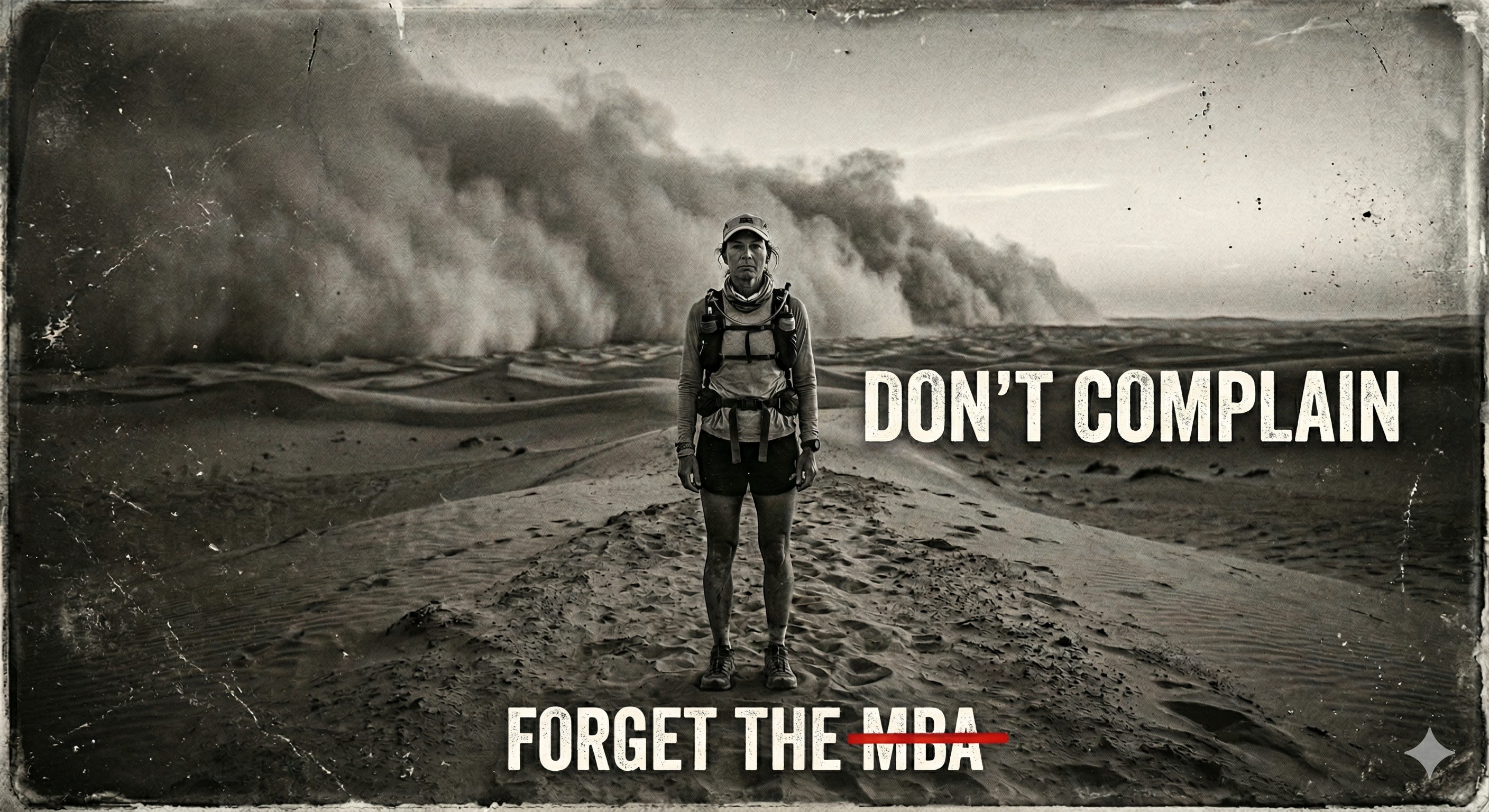
Last year, I was sleeping in the middle of the Sahara Desert when an unexpected sandstorm blew our tent away.
Ours and about 200 others.
We were running the Marathon Des Sables, a 250km race across the Sahara, famously dubbed the toughest foot race on earth.
Our team, along with roughly 100 others, had to scramble in the middle of the night to retrieve the tents, drag them back, and re-anchor them against the howling north winds.
By the time everything was secured, we had maybe three hours of sleep before the next morning’s 100km stage.
An authentic nightmare.
But what stayed with me wasn’t the ferocity of the storm.
It wasn’t waking up in a sleeping bag full of sand.
It was something subtler:
The near-total absence of complaining the next morning.
That night reminded me of something I’d read in The Rise of Ultra Runners, one of the best running books I’ve come across since Born to Run.
Adharanand Finn, the author, describes arriving at his very first ultra race, only to be blindsided by a logistics delay that forced the entire group to sleep in the airport.
He was furious.
“What kind of organization is this? Is this what we paid for?”
He vented loudly.
Meanwhile, the dozen seasoned ultra runners around him quietly grabbed a patch of floor, closed their eyes, and went to sleep.
Later in the book, after dozens of ultras under his belt, he looks back on that airport night with embarrassment.
He finally understood what the others already knew:
Play the cards you’re dealt, keep moving, and don’t waste energy on complaining.
The Business Version
A colleague asked me recently what single trait I look for most when hiring.
I didn’t hesitate.
People who don’t complain.
But the best ones go even further than that.
They’re not just indifferent to adversity.
They’re genuinely grateful for it.
When the sandstorm hit at 2am in the Sahara, the veterans in the camp weren’t just tolerating it.
Some of them were almost smiling.
Because they already knew what the rest of us were still learning:
That’s the race. The hardship isn’t a detour from the experience. It IS the experience.
The best founders carry that same mentality.
When a deal collapses, when a key hire walks out, when the product breaks in front of a customer, there’s no victim story. No “why does this always happen to us.”
Just: what do we do in the next five minutes?
And here’s why it matters beyond mindset:
If your instinct in hard moments is to complain, to your team, to yourself, even just inside your own head, you are burning the one resource you cannot replenish:
Energy.
Because while you’re explaining why the storm wasn’t your fault, someone else is already re-anchoring their tent.
Why Complaining Is So Expensive
Most people underestimate the cost of complaining.
It’s not just the time spent venting.
It’s what happens to the room.
One complainer drains the energy of an entire team. They introduce doubt. They slow decisions. They make hard moments feel harder than they already are.
The best operators compress the reaction time between “something went wrong” and “here’s what we’re doing about it.”
That compression is one of the most valuable skills a founder or operator can have.
Charlie Munger put it better than anyone:
“I have a theory that the dumbest thing you can do in life is feel like a victim. Even if you are a victim, I think it’s a mistake.”
Lesson Learned:
The real test isn’t how someone performs when everything goes to plan.
It’s what they do when the sandstorm hits at 2am.
3-2-1 Sprint
3 Ideas
Compress the reaction gap. The time between “something went wrong” and “here’s what we’re doing” is a skill you can train.
Audit your energy leaks. Look in the mirror and identify when you are complaining.
Play the cards you’re dealt. The storm doesn’t care about your plan. Neither does the market.
2 Quotes I
“I have a theory that the dumbest thing you can do in life is feel like a victim. Even if you are a victim, I think it’s a mistake.” Charlie Munger
“It is not the strongest or most intelligent who survive, but those most adaptable to change.” Charles Darwin
Final Thoughts
Most people think resilience is about toughness.
It’s not.
It’s about how fast you can accept what happened, stop explaining why it’s unfair, and get back to work.
The runners in the Sahara weren’t tougher than everyone else.
They just knew the faster they dealt with the soprano, the sooner they would be sleeping.
That’s the real skill.
Thanks for reading.
Share Forget the MBA: