
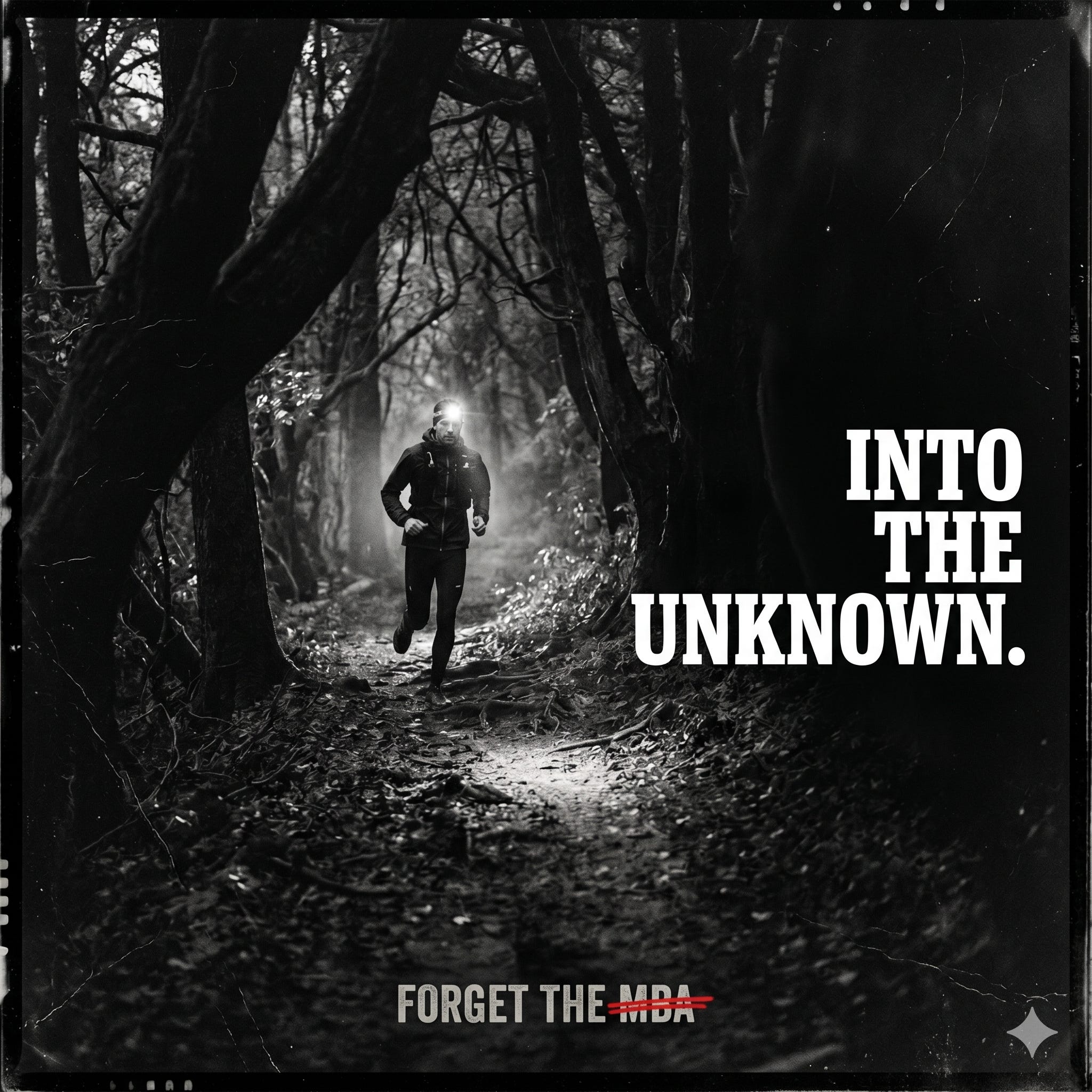
A few weeks ago, a good friend called me the night before his first half-marathon.
He had trained. Not perfectly, but enough. His longest run had been 13k. The full 21k was still unknown territory.
I expected the usual pre-race questions. What to eat. How many gels. How to control the pace.
Instead, he said this:
“I just ran 21k. I know I will make it tomorrow.”
I didn’t respond. I genuinely had no words.
He had run the race. The night before the race. Not as a warm-up. As proof.
“I know I shouldn’t have,” he said. “But I needed to know if I could.”
That sentence hasn’t left me since.
Why did he do it?
When It Gets Real
What he did wasn’t stupid. Well, it was. But it was also deeply human.
Nicholas Carleton, one of the leading researchers on human psychology, argues that the fear of the unknown is the most fundamental fear we have. Not failure. Not pain. The not-knowing.
My friend didn’t fear the half-marathon. He feared the unknown. He traded arriving exhausted at the actual race for certainty. He mortgaged tomorrow to feel okay today.
This is exactly what so many professionals are feeling with the AI wave.
They’re not afraid of the technology. They’re afraid of the unknown it brings.
Will my job be replaced? Is this technology only for the tech-savvy? Will my company be outrun by an AI-first startup?
With so many open questions, naturally, many of us freeze.
On the other end of the spectrum, there are people who are actually okay with the uncertainty that a new technological revolution brings. It’s not that they are comfortable, but they have what it takes to keep moving in uncertain waters.
AI early-adopter data shows that people who do step in aren’t discovering a threat. They’re discovering a ceiling much higher than the one they assumed existed.
Worth Your Time
Antifragile by Nassim Taleb. The core argument: some things don’t just survive uncertainty, they get stronger from it. If your business strategy requires knowing the outcome before you commit, you’re fragile. This book rewires how you think about risk and why volatility is an asset, not a threat. One of the most useful reads for any founder operating in chaos.
Final Thoughts
Dealing with ambiguity is a muscle. And like any muscle, it atrophies if you don’t train it.
The world isn’t getting more predictable. The only edge left is the willingness to step into the unknown.
Thanks for reading.
Share Forget the MBA: