

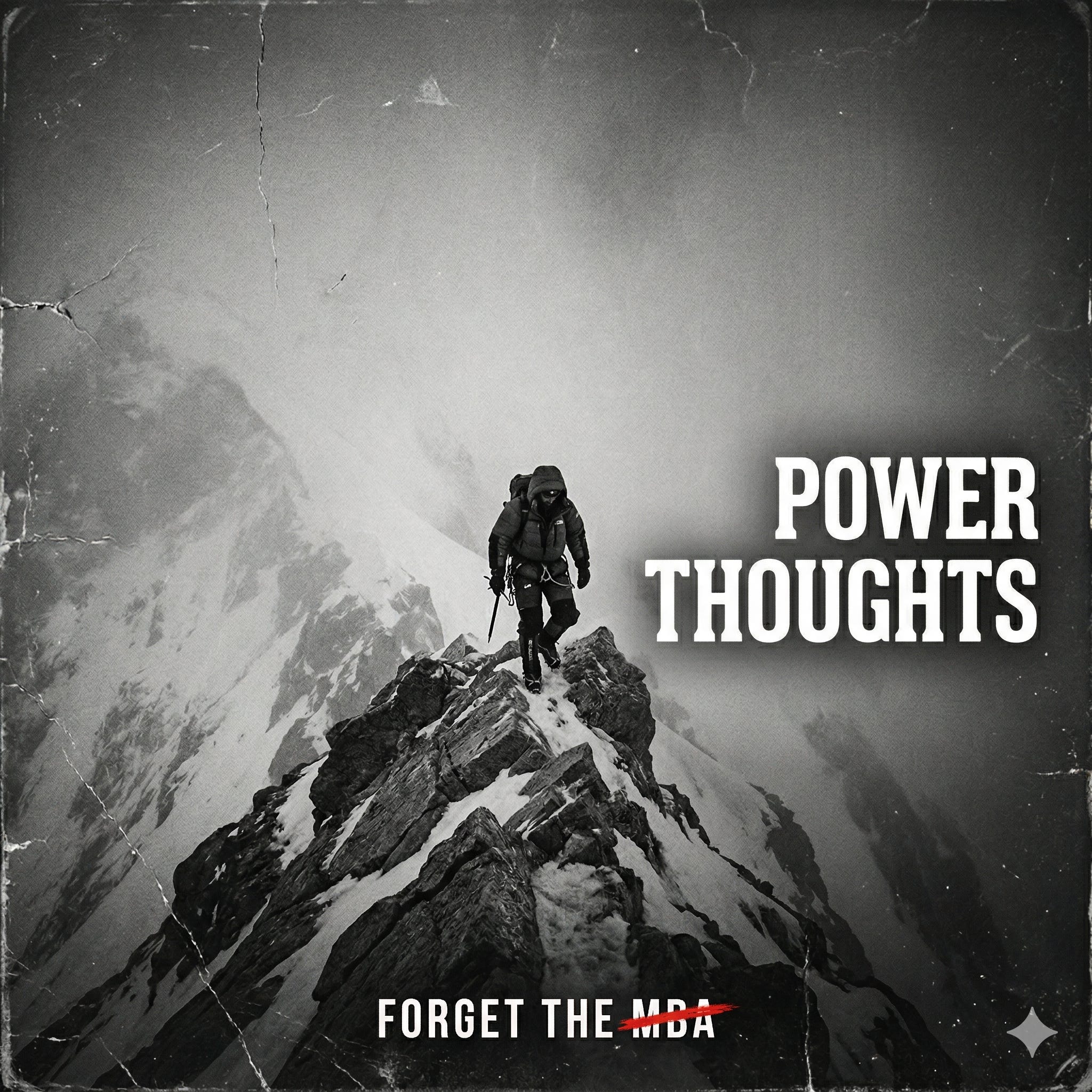
Mile 128 of the Sahara Desert ultramarathon.
My feet have been numb since mile 62. The sun has cooked through my buff, and I can feel it on my skull. I’ve got three liters of water left, no shade for the next 11 kilometers, and my legs are having a conversation with my brain that I don’t want to be a part of.
This is the moment when no pump-up song can bring your motivation back.
Lady Gaga or Bad Bunny won’t fix this. Neither is a power gel, caffeine, or anything else in the biology playbook. At this level of depletion, the body has stopped listening to hacks. The only thing left is something deeper, the one item the body will not find, but the mind can.
A few years ago, I saw a podcast that featured Luis Alvarez, a businessman, adventurer, and a man who treats life like it’s running out. One of his feats: five Ironmans, five days, five continents.
But it’s his Mt. Everest ascent that stayed with me.
After reaching the summit, his goggles fogged on the way down. At minus 50 degrees Fahrenheit, the condensation froze solid on the lenses. He switched to his spares. Same result. The descent was technical, exposed, and nearly vertical in sections. He kept moving without them.
By Camp IV, at 8,300 meters, still in the death zone, he had gone blind for not having worn eye protection. His corneas had burned.
What kept him moving?
Not willpower. Not a mantra. No caffeine shot.
One thought, simple yet infinitely powerful: If I die here, my son will carry the burden of having sent me to my death.
When Luis asked for it, his son gave his dad his blessing to embark on the expedition. The boy was only 15, and Mr. Alvarez could not live with the burden of thinking his son would feel guilty of his father’s death
That thought, that single, specific, non-negotiable thought, pulled him off the mountain alive.
It is much easier to let oneself down than to let a loved one down.
When It Gets Real
An old and wise marathon coach taught me this technique. Deep, motivating mind visualizations. He called them Power Thoughts.
A Power Thought is the one idea that survives even in the darkest moments. It connects to something outside yourself, a person you refuse to let down, a commitment you made before the odds got long, a version of the future you owe someone else.
“When nothing else works,” he used to say.
A few weeks before any major race, I choose five. I write them on my left forearm in permanent marker. After dozens of miles into a race, my head sometimes won’t work properly, so I need them to be visible.
What is interesting is that the best Founders deploy the same system.
Howard Schultz, founder of Starbucks, grew up in a Brooklyn housing project. His father drove a truck. When Schultz was seven, his father broke his ankle on a delivery and was fired. No insurance. No plan.
Schultz never forgot the look of a man made helpless.
That image became his anchor; it became his Power Thought. Every time Starbucks hit a wall, he says he came back to one thought: his helpless father and the people in his stores, who cannot end up like him.
In 2008, during a crisis, the share price was down 42%, stores were closing, and the board was demanding cuts. Schultz returned as CEO and, on day one, canceled a $20 billion stock buyback to reinvest in employees instead, a very tough decision at the time. Analysts called it reckless, but it was the single most important factor in turning the company around.
He didn’t calculate it. When nothing else was working, he returned to the one thought that outranked everything else.
That’s the success cheat. You don’t eliminate the hard thing. You use it to have something truly worth bleeding for.
Lesson Learned:
When willpower runs out, motivation takes over. But motivation only works when you have something worth fighting for.
Worth Your Time
The Comfort Crisis by Michael Easter. Easter’s argument is simple and uncomfortable: modern life has systematically removed the conditions under which mental strength is built. He documents what happens physiologically and psychologically when people deliberately seek discomfort — and why that exposure produces exactly the kind of resilience Power Thoughts tap into. Directly relevant to anyone who wants to build the mental infrastructure before they need it.
Have a great week.
Thanks for reading.
Share Forget the MBA: