

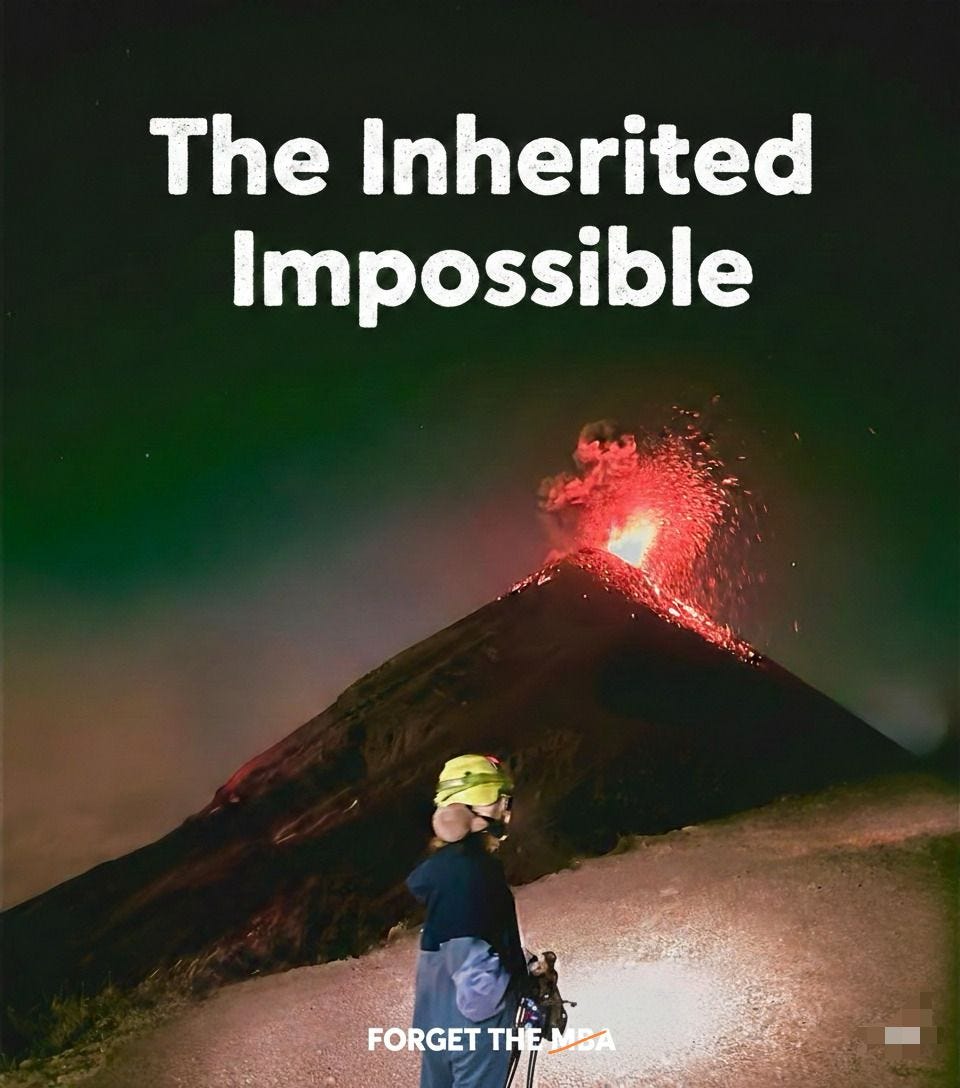
Last week, I climbed Volcán de Acatenango to witness the breathtaking eruptions of Volcán de Fuego — an active volcano standing over 3,800 meters. I did this with my whole family, including my three kids: ages nine, seven, and six.
Before embarking, most people told me the same things.
“Kids can’t do that. Only adults are able.”
“They’ll get altitude sickness. It’ll be a nightmare.”
“They’ll get bored. They’ll be miserable. You’re going to ruin the experience for them. ”
Everyone had a reason it wouldn’t work. Everyone was certain. And nearly everyone, it turned out, was completely wrong.
I had climbed with them on a few less demanding ascents, and based on those experiences, I assessed that they were more likely to make it than not. So I paid the deposit.
The Climb
Volcán de Fuego is not a casual hike. The ascent takes six hours with over 1,000 meters of vertical gain. The terrain shifts from dense jungle to loose volcanic rock and to open ridge.
We started early. The kids — a nine-year-old girl leading the charge, a seven-year-old boy in the middle, and his six-year-old brother at the back doing his own thing at his own pace. We set off up the trail without ceremony, without complaint, and without any apparent awareness that what they were doing was supposed to be beyond them.
I’ll be honest: inside my head, I was nervous. Not at all certain they would summit. As we climbed, I kept a quiet eye on their pace and mood, ready to make the call to turn back.
The first few hours were steady. Other adult groups passed us on the way up with polite smiles—the kind that said they admired our ambition even if they doubted the outcome.
Then something shifted.
Around the halfway point, the altitude began to wear people down. Pace slowed. Stops became more frequent. Conversations shortened. The mountain was collecting its toll — and that’s when we started passing people.
As we moved through groups, you could hear it:
“Don’t complain — look at those kids.”
Adults coming down after a night at camp would spot my kids and nudge each other. Adults we were overtaking would fall quiet as my six-year-old moved past them at a pace they could no longer match. Almost all of them laughed — not mockingly, but with genuine disbelief. One man shook his head and smiled at me. I replied with a face that said: I have no explanation for this either.
It wasn’t all smooth going. They struggled at times, like anyone else. But they recovered, forgot about it, and kept moving. That part, I noticed, was distinctly un-adult of them.
The Last Mile
The final stretch is a different kind of suffering. The trail flattens slightly before the last push, but by that point, most adults are running on empty. People who had been confident at the base were now shuffling. Nobody was talking. The mountain had stripped everyone down to something very basic: one foot, then the other.
That’s when my kids started running.
Not jogging. Running.
They had sensed the end was near, and I stopped holding back their urge to sprint to the finish. They bolted. Our mountain guide — a man with a rugged face from decades of alpine sun, who had climbed this volcano more times than he could count — looked at me and burst out laughing.
“The energy kids have,” he said, shaking his head. “It’s mind-blowing.”
He wasn’t wrong. But standing there watching them go, I had a different thought entirely.
It wasn’t their energy that was mind-blowing. It was their absence of doubt.
“It always seems impossible until it’s done.” — Nelson Mandela
What Kids Know That We’ve Forgotten
Adults carry invisible weight up a mountain. We know how hard it’s supposed to be. We’ve heard the warnings. We’ve calculated the distance, read the elevation, and prepared ourselves for failure before we’ve even begun. By the time we take the first step, we’re already negotiating — with ourselves, with the mountain, with our limits.
Children don’t do this. They haven’t yet learned that certain things are supposed to be out of reach. They haven’t accumulated the library of limitations that adults carry around like a second backpack. Ignorance is bliss.
My six-year-old didn’t know he was too young for this. My seven-year-old hadn’t logged enough experience to know he should be worried. My nine-year-old had no idea that the adults struggling behind her were thinking she wouldn’t make it. They just hiked — playfully, stubbornly, without a script.
The ceiling isn’t the volcano. The ceiling is the story we tell ourselves before we even get there.
The warnings people gave me were not based on my children’s actual capabilities. They were based on assumptions, their own fears, and limitations.
I’m not saying take your kids to unreasonable extremes. Assess the risks. Do the homework. But I will never stop asking myself: am I seeing my children’s limits clearly, or am I projecting my own? How much of what I believe about what they can’t do is real — and how much is a ceiling I accepted before they ever had the chance to test it?
Looking back, I’m still in awe. Not because my kids are superhumans, but because they didn’t just do it — they plowed past most of the adults on the mountain. I couldn’t have been more wrong to doubt them. They weren’t just capable. They were beyond anything I had expected.
Questions to Ask Yourself
Where in your life have you accepted a limit that was handed to you, rather than one you discovered yourself?
Is there something you’ve told yourself — or someone around you — is “too hard” or “not realistic”? What would actually happen if you tested that assumption?
When was the last time you attempted something you weren’t sure you could do?
Burn the Playbook
Don’t ask or give out ‘easy.’
We think protecting people from hard experiences is kindness. It isn’t. Most of the time, it’s a limitation with better PR. The most damaging thing you can do to someone is deprive them of a difficult experience. Or even worse, it’s defining a ceiling they didn’t build and were never asked to question.
End Note
“Whether you think you can, or you think you can’t — you’re right.” — Henry Ford
Most of us aren’t held back by our own conclusions. We’re held back by conclusions we inherited. My kids didn’t summit that volcano because they were extraordinary. They summited because nobody had convinced them yet that they shouldn’t be able to.
Worth asking what you’ve accepted as impossible that you’ve simply never tried.
Thank you for reading.
Share Forget the MBA:
Muy bueno, estaría igual de bien ver esto tipo de artículos en español.
I guess you felt indescribably proud of your kids and yourself! Congrats Juank!
When my son overcomes a difficult challenge, he always tells me, "Everything is possible, Dad."